
Description
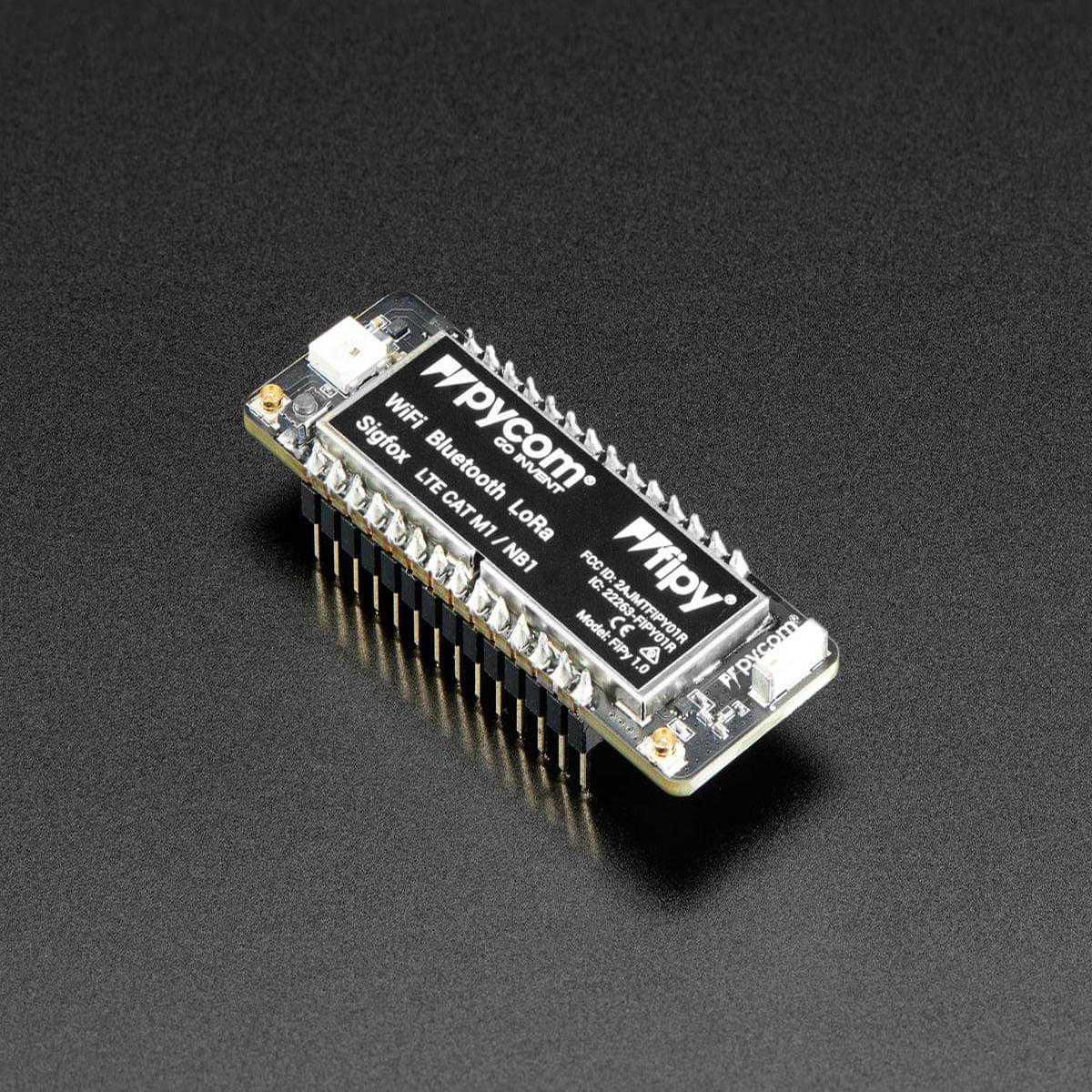
Some of us just can\’t make up our minds: just deciding what to have for dinner is a major decision process. We want it all! And now we can have it all, with this python-powered internet-of-things powerhouse. It\’s like getting to have pizza AND sushi AND tacos AND casserole AND a burger for dinner, wow! Imagine five networks in one perfectly-formed, same-small-foot-print-as-WiPy- LoPy-and SiPy, IoT development board. MicroPython enabled. FiPy includes WiFi, Bluetooth LE, LoRa, Sigfox and dual LTE-M (CAT M1 and NBIoT). That means you never have to pick-and-choose your IoT transport ever again – the FiPy gives access to all the worlds LPWAN networks on one bitty board. This one-of-a-kind board gives you full flexibility during testing, install, deployment and even later when you want to switch real-time your airtime network provider. You can switch when the time is right for you or set some parameters that will do so automatically. The FiPy has a built-in operating system that supports MicroPython, the lightweight cousin of the Python web programming language. You can use this board as is, or develop your application, then minimize the design with one of the smaller and simpler Pycom boards (if, say, you realize you don\’t need SigFox or Cellular) Comes with just the dev board. You\’ll need an antenna for each transport you want to use other than WiFi/BLE (which has a ceramic antenna built in). Using a transport without an antenna can damage the board! LTE Cellular Antenna 900 MHz Antenna Kit (LoRa and SigFox) 2.4 GHz Antennas (for WiFi) – not required but will get you much better range than the built-in antenna For LTE you\’ll also need a SIM card with data that can go on an LTE network. Technical Details Features Powerful CPU Five networks: WiFi, BLE, cellular LTE-CAT M1/NB1, LoRa and Sigfox 1KM WiFi range MicroPython enabled Fits in a standard breadboard (with headers) Ultra-low power usage: a fraction compared to other connected microcontrollers Open source firmware Processing Espressif ESP32 SoC Dual processor and WiFi radio system on chip Networking processor handles the WiFi connectivity and the IPv6 stack Main processor is entirely free to run the user application An extra ULP-coprocessor that can monitor GPIOs, the ADC channels and control most of the internal peripherals during deep-sleep mode while only consuming 25uA Interfaces 2 x UART, 2 x SPI, I2C, micro SD card Analog channels: 812 bit ADCs, 28 bit DAC Timers: 264 bit with PWM with up to 16 channels DMA on all peripherals GPIO: Up to 22 Hash / Encryption SHA, MD5, DES, AES WiFi Networking 802.11b/b/n 16mbps Bluetooth Low energy and classic RTC Running at 32KHz Range Node range: Up to 50km Security & Certifications SSL/TLS support up to 1.2 WPA Enterprise security AES encryption engine Memory RAM: 4MB Flash Memory: 8MB GPIO: Up to 22 Hardware floating point acceleration Python multi-threading Power Voltage Input: 3.3V 5.5V 3v3 output capable of sourcing up to 400mA Sigfox Operating Frequencies RCZ1 868MHz(Europe) RCZ2 902MHz (US, Canada and Mexico) RCZ3 (Japan and Korea) RCZ4 920-922MHz (ANZ, Latin America and S-E Asia) Sigfox Specification TI CC1125NarrowbandTransceiver Class 0 device. Maximum Tx power: +14dBm (Europe) +22dBm (America) +22dBm (Australia and New Zealand) Node range: Up to 50km Sigfox pre-certified (October 2016) Power Sigfox (Europe): 17mA in Rx mode, 47mA in Tx mode and 0.5uA in standby Sigfox (Australia, New Zealand and South America): 24mA in rX mode, 257 mA in Tx mode and 0.5uA in standby Bluetooth Networking Low energy and classic Compliant with Bluetooth v4.2 BR/EDR and BLE specification Class-1, Class-2 and Class-3 transmitter without external power amplifer Enhanced power control +10dBm transmitting power NZIF receiver with -98 dBm sensitivity Adaptive Frequency Hopping (AFH) Standard HCI based on SDIO/SPI/UART High speed UART HCI, up to 4 Mbps BT 4.2 controller and host stack Service Discover Protocol (SDP) General Access Profile (GAP) Security Manage Protocol (SMP) Bluetooth Low Energy (BLE) ATT/GATT HID All GATT-based profile supported SPP-Like GATT-based profile BLE Beacon A2DP/AVRCP/SPP, HSP/HFP, RFCOMM CVSD and SBC for audio codec Bluetooth Piconet and Scatternet LoRa Operating Frequencies 868MHz(Europe) at +14dBm maximum 915MHz (North and South America, Australia and New Zealand) at +20dBm maximum LoRa Specification Power consumption: 10mA Rx, 28mA Tx LoRaWAN stack Class A and C devices Node range: Up to 40km Nano-gateway: Up to 22km (Capacity up to 100 nodes) LTE-M Operating Frequencies 4 bands supports from 699Mhz to 2690Mhz (Total world-wide support) LTE-M Specification One single chip for both CAT M1 and NB1 (yes, only one chip) 3GPP release 13 LTE Advanced Pro Supports narrowband LTE UE categories M1/NB1 Integrated baseband, RF, RAM memory and power management Reduced Tx power class option Peak power estimations: TX current = 420mA peak @1.5Watt RX current = 330mA peak @1.2Watt Data rates: 300 kbps DL 375 kbps UL (LTE Cat M1 in 1.4 Mhz, HD-FDD) 40 kbps DL 55 kbps UL (LTE Cat M2 in 200 kHz, HD-FDD) Tx/Rx Frequencies Ports for LTE Bands Tx frequencies Rx frequencies Low bands 5, 8, 12, 13, 18, 19, 20, 28 699 to 915 MHz 729 to 960 MHz Mid bands 1, 2, 3, 4 1710 to 1980MHz 1805 to 2170 MHz WiFi Networking Up to 1km range 802.11b/g/n 16mbps Power: 12mA in active mode, 5uA in standby Dimensions 55m x 20mm x 3.5mm (without headers) For product support you can contact Pycom here Product Dimensions: 54.0mm x 20.0mm x 9.6mm / 2.1\” x 0.8\” x 0.4\” Product Weight: 8.6g / 0.3oz

Reviews
There are no reviews yet.